Archive for the ‘BodyBuilding’ Category
Asked the doc if I can go on Tadalafil – They said yes
 August 11th, 2026 |
  Author:
 Tadalafil is Cialis — the “boner pill.” I didn’t start it for that. I started it for BPH, an enlarged prostate.
I just turned 58 and the old-man problems are stacking up. The first real one was pissing. It got harder. You finish and then you need to go back three or four times. Not a crisis, just annoying. My PSA was high too. I don’t care. I’m nearly 60. Nobody is sticking a finger up my arse for a DRE. If they want a look at the prostate they can do an MRI. Prostate cancer? Pretty much everybody gets some of it eventually. It’s the least of your problems at this age.
So tadalafil is symptom treatment for me. And it works.
Morning wood is back and stronger. The stream is better — cleaner, more complete, less of the stop-start nonsense. That alone made it worth trying. If the PSA stays high or climbs further I’ll look at a DHT blocker. That’s the line. No biopsies. No cancer treatments. Not interested.
At the same time I’ve dropped 45 lbs of fat. I haven’t been this weight since my late twenties. Training feels different now. I’m starting to feel pretty damn good from the fat loss but just felt the same until my BF% got to mid 20’s. From what I have read under 20% is when you really get the health benefits & feel the spark. Bring it on.
What the research actually shows
Daily low-dose tadalafil (the 5 mg range used for BPH) does more than just open the plumbing and help the erections.
It is a PDE5 inhibitor. It keeps nitric oxide signalling going longer, which relaxes blood vessels system-wide. Better blood flow means fuller pumps in the gym, more oxygen and nutrients getting into working muscle, and faster clearance of metabolic waste. That shows up as better endurance during sessions and less residual soreness.
There is also solid human data on body composition. In a randomised trial of non-obese men around my age with mild ED or LUTS, 5 mg daily for two months produced a clear increase in abdominal lean mass. The gain reversed when they stopped the drug. The same study showed improved endothelial function, a better testosterone-to-estradiol ratio, and higher insulin levels that correlated with the lean-mass change. Lab work on muscle cells showed increased androgen receptor expression and myogenin — the machinery that responds to androgens and drives muscle development.
Other work links the same nitric-oxide/cGMP pathway to better insulin sensitivity, improved glucose uptake into muscle, and support for mitochondrial function. Cardiovascular data is interesting too: large observational work has associated PDE5 inhibitor use with meaningfully lower rates of cardiac events and mortality. Some cognitive studies have shown increased cerebral blood flow, though the Alzheimer’s prevention data is mixed.
How I’m using it
For me it’s primarily the BPH and the stream. The morning wood improvement is a welcome side effect. The gym benefits — better pumps, slightly better recovery between sets, the overall sense that blood is moving better — sit on top of that. I’m not chasing some magic anabolic effect. I’m using a drug that is already approved for the prostate symptoms I actually have, and taking the extra circulatory and body-composition signals as a bonus while I continue training and eating for fat loss.
I’ve now lost 45 lbs. The scale is back where it was in my late twenties. Strength is holding, energy is better, and the constant low-level irritation of incomplete emptying is gone. That combination has me feeling pretty sharp although I always feel good.
Symptom control first. Everything else is secondary . Why? Because Urologists will rape your ass, rob you & call it a cure. If the numbers stay high later I’ll add a DHT blocker. Until then this is working.
 Posted in
DEXA scan number 4
A further 6kg lost since the last scan 6 weeks ago.
Some bad news was 2kg muscle loss but I know why. I cut way back on creatine.
I had a cold for 7-9 days so didnt train or take creatine but was still in deficit. Then when I started training again I did not take creatine on non training days, thats 2-3 per week. On top of that some days I forgot to add it to my drink.
All up that means of the 6 weeks I did not have creatine for 3-4. This does explain a 2 kg drop in mass.
Hope so anyway as I am continuing to the bitter end, the fat must go. Loading creatine hard to regain any loss.
Body fat was 28% but if I claw back 2-3 kg with the creatine then its down to 26-27%.
This means I can start a once per week carb load and i shall. I do not want muscle loss at all.
I will deficit down to 19-20% bodyfat then begin lean bulking. End goal 14% bodyfat. Preferably at 100kg but there will be some muscle building to do.
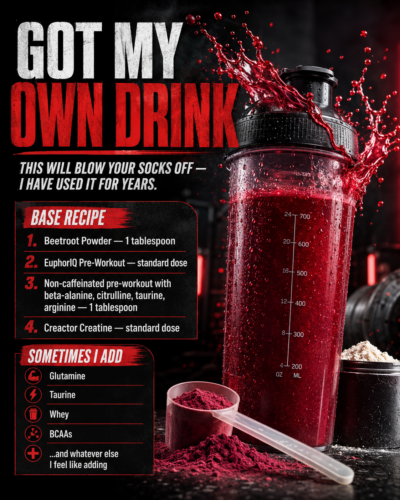
The Lethal Dose: Gareths Gym Jungle Juice
Got my own drink – this will blow your socks off I have used it for years.
1: Beetroot Powder – 1 table spoon
2: EuphorIQ preworkout – standard dose
3: Inspired Pump Non caffein preworkout with beta-alinine, citriline, Taurine, Arninine – 1 tablespoon
4: Creactor Creatine – standard dose
Thats the base recipe but sometimes I add glutamine, Taurine, whey, BCAAs and whatever
DEXA 3 week 14
Zero muscle loss in six weeks. & I am now below 30% bodyfat.
Also no longer clinically obese.
But I still ahve a long way to 14%
I lost 25 lbs of fat in 10 weeks
Yeah my DEXA way back at the start was 35% bodyfat
That triggered me into action. I slashed calories massively and began VLC dieting but the first 6 weeks I still had a mix of macros.
Hunger was low with such a high body fat & I calculated I had over 180,000 calories in storage.
Fatigue has been an issue and only muscletech euphoriq preworkout seems to work for me. I tried caffein – terrible. I tried paraxanthine alone – has no kick.
But that one brand of preworkout sets me on fire & I can train like a demon while starving.
Second DEXA was at week 6 – 8 lbs of fat lost but alas 1 lb of muscle also.
Bodyfat still high 32.7% so I was very dissappointed considering how little I was eating.
I decided to try harder, switched to PSMF which I remain on today.
Weight plummeted immediately but has now plateaued at 96kg. I have no idea what my current bodyfat percentage is and my next DEXA is booked in 3 weeks.
I do look much slimmer but feel very weak and depleted. Have to have that preworkout. Strength actually has increased I am a demon. Endurance also.
My goal 14% bodyfat by late July. Possible but keen.
One last note my start weight was 107kg not the 104 on the first DEXA. That was dehydrated on no breakfast.
 Tags:
Tags: My Coronary Calcium Score: What a Score of 0.9 Actually Means
First up my score was good and puts me at the same risk level as an average under 30 years old. But half of all males my age have a similar score. With that said lets begin.
I recently had a CT coronary calcium score done to get an objective assessment of cardiovascular risk—beyond blood tests, family history, or population-based risk calculators.
This test detects calcified plaque in the coronary arteries. Not cholesterol in the blood. Not soft plaque estimates. Actual, measurable coronary atherosclerosis.
The Result
My coronary calcium score came back as:
-
Agatston score: 0.9
-
Location: a single microscopic fleck in the right coronary artery (RCA)
-
Total calcified volume: 0.80 mm³
-
Equivalent calcium mass: 0.31 mg
This sits in the lowest end of the “minimal identifiable calcification” range and is clinically close to zero, but not zero.
Risk Reclassification: The Key Point
Before imaging, my estimated 5-year cardiovascular disease (CVD) risk—using New Zealand PREDICT models—was approximately 6%.
Once the calcium score was incorporated, that risk was reclassified downward to ~3% over the next 5–7 years.
This is the intended role of calcium scoring: it refines statistical risk estimates using direct imaging evidence
How Common Is a Calcium Score of 0.9 at Age 57 (Male)? — Properly Stated
Context matters, so here is the accurate population framing.
For men aged 55–59 in large cohort studies:
-
~45–55% have a calcium score of 0
-
~20–30% have scores 1–10
-
~15–20% have scores 11–100
-
~10–15% have scores >100
A score of 0.9 therefore places me just above the median, within the lowest-risk half of men my age. It is favorable but not rare, and it should not be framed as exceptional.
Clinically, scores in the 0–1 range are treated very similarly in short- to mid-term risk prediction—but statistically, 0.9 is not the same as 0, and the distinction matters.
What a Score of 0.9 Does Not Mean
It does not mean:
-
Zero lifetime risk
-
Immunity from atherosclerosis
-
That lifestyle factors no longer matter
What it does mean is that there is no meaningful calcified plaque burden at this point in time, and no imaging evidence of established coronary disease.
The report also estimates a coronary age under 30, based on international reference databases.
Statins: Optional, Not Mandatory
Because of the low calcium score, primary-prevention statin therapy is explicitly described as optional.
A conservative clinician could still argue for low-dose statins based on cholesterol levels or family history, but the scan itself does not mandate pharmacological intervention.
The recommended course if statins are not used is simple:
-
Repeat calcium scoring in 5 years
-
Monitor progression rather than assume risk
Why This Test Was Worth Doing
Blood markers fluctuate.
Risk calculators generalize.
Imaging shows reality.
Calcium scoring answers a direct question:
Is there measurable coronary artery disease right now?
In my case, the answer is minimal and clinically insignificant.
Final Thought
A calcium score of 0.9 is not a trophy and not a warning sign.
It’s a baseline measurement.
The objective now is straightforward:
-
Prevent progression
-
Re-image at the appropriate interval
-
Let objective data—not assumptions—drive decisions
That’s what modern preventive cardiology is for.
What My DEXA Scan Actually Told Me (And Why It Matters)
I recently had a full-body DEXA scan done. Not for vanity. Not for a before-and-after Instagram post. I wanted hard numbers—objective data that cuts through guesswork and tells the truth about body composition, fat distribution, and muscle mass.
DEXA is often talked about in vague terms, so I want to document exactly what mine showed and how I’m interpreting it.
The Raw Numbers
At the time of the scan, my stats were:
- Height: 177 cm
- Weight: 104.7 kg
- Total body fat: 35.0%
- Fat mass: 35.3 kg
- Lean mass: 65.5 kg
- Relative Skeletal Muscle Index (RSMI): 10.40 kg/m²
- Resting Metabolic Rate (RMR): 1,776 kcal/day
This immediately tells an important story: I’m not under-muscled. My RSMI sits well above sarcopenia thresholds and is consistent with a strong, load-bearing frame rather than a frail or skinny-fat profile
Muscle Distribution: The Good News
Segmental analysis showed that muscle mass in my arms and legs is solid and well balanced left-to-right. Legs in particular carry a large amount of lean tissue, which aligns with strength and movement capacity rather than inactivity.
In other words: this is not a “lost muscle” problem. It’s a fat distribution problem layered on top of a muscular base
That distinction matters because it completely changes the strategy.
Where the Fat Is (And Why That’s the Priority)
The scan highlighted elevated fat concentration in the trunk and android (abdominal) region:
- Trunk fat: ~44%
- Android fat: ~48%
- Visceral Adipose Tissue (VAT): ~2.8 kg
Visceral fat is the metabolically active kind—the type associated with insulin resistance, cardiovascular risk, and inflammatory signaling. This isn’t about aesthetics. This is about risk management.
The DEXA heat map makes this impossible to ignore: the issue is central fat, not overall size.
Why Scale Weight Is a Terrible Metric
If I lost 15–20 kg without preserving muscle, the scale would look great and the outcome would be worse.
DEXA makes it clear that the correct objective is:
- Reduce fat mass aggressively
- Preserve (or even improve) skeletal muscle
- Shift fat distribution away from visceral storage
That’s not something you track with a bathroom scale.
Metabolism: No Excuses Here
An RMR of ~1,776 kcal/day is normal for my lean mass. There’s no “broken metabolism” narrative to hide behind. Fat loss here is not about metabolic damage—it’s about sustained energy control and consistency.
That’s actually good news, because it means the system responds predictably when the inputs are correct.
The Real Value of This Scan
What this scan gave me is clarity.
- I know muscle is not the limiting factor.
- I know exactly where the fat is.
- I know what type of fat matters most.
- I have a baseline that future scans can objectively compare against.
This turns body recomposition into an engineering problem instead of a motivational one.
Final Thought
Most people never get this level of feedback. They chase weight loss blindly, lose muscle, stall, and then assume age or genetics are the problem.
DEXA removes the guessing.
Now it’s just execution.
My Journey with Losartan: A Game-Changer for Age-Related Hypertension in Active 50-Somethings
I’m 57, and like many fitness-minded people my age, I’ve always prioritized training—HIIT, hill climbs, weights, Zone 2 cardio—you name it. I eat clean, stay lean, and push my VO2 max higher every year. But no matter how hard you train, age-related hypertension can creep in. It’s like getting gray hair: inevitable for some of us, no matter how fit we are.
Six weeks ago, my blood pressure was sitting at 170/100 despite all my efforts. My doctor started me on losartan, an angiotensin II receptor blocker (ARB), and the results blew me away—I’m ARB-sensitive, and within a week, it dropped dramatically to 117/77. Now it’s stable in the ideal range.
Losartan isn’t just a blood pressure pill; for active people like us, it unlocks a host of benefits that align perfectly with a training lifestyle. It relaxes blood vessels, reduces strain on the heart and organs, and blocks harmful inflammation and oxidative stress. Research shows that combining losartan with regular exercise makes it far more effective—studies indicate greater blood pressure reductions, better autonomic heart control, improved exercise tolerance, and enhanced cardiovascular adaptations when you’re physically active compared to sedentary users.
Core Benefits for Heart and Blood Pressure Control
Losartan excels at lowering blood pressure and protecting the cardiovascular system. It reduces stroke risk, reverses heart enlargement (left ventricular hypertrophy), and uniquely lowers uric acid levels—great if training sometimes spikes those. For active folks, it blunts exaggerated blood pressure spikes during intense workouts, making hard sessions feel smoother without blunting performance (unlike beta-blockers that can sap your power).
Kidney Protection—Essential for Long-Term Training
Intense exercise stresses the body, and over time, high blood pressure can tax the kidneys. Losartan is proven to slow kidney damage, especially in conditions like diabetic nephropathy, by reducing protein in the urine. Staying active amplifies this protection, helping maintain filtration efficiency so you can keep training hard into your 60s and beyond.
Brain Health and Cognitive Sharpness
As we age, preserving brain function is key for everything from quick decision-making in sports to long-term mental edge. Emerging studies show losartan may reduce brain inflammation, improve memory, and lower risks of cognitive decline or dementia. For fitness-minded people, better blood flow and reduced oxidative stress mean sharper focus during workouts and faster recovery mentally.
Anti-Aging and Muscle Support
Losartan counters cellular aging by protecting telomeres and reducing inflammation/oxidative stress. In animal models, it boosts muscle strength and activity in older subjects. Combined with training, it promotes better muscle adaptations—I’ve noticed easier recovery and sustained performance since starting.
Why Losartan Works Even Better for Exercisers
Here’s the exciting part: science backs that physical activity supercharges losartan’s effects. Aerobic exercise enhances its impact on heart rate variability and autonomic regulation, leading to superior blood pressure control and cardiac function. In hypertensive patients who train, losartan improves exercise tolerance, blunts hypertensive responses during effort, and supports greater overall gains—like increased ventricular contractility and vessel elasticity. Sedentary users get solid BP lowering, but active ones see amplified benefits across the board.
Other Emerging Perks
- Stronger anti-inflammatory and antioxidant effects to combat training-induced stress
- Potential in eye health (like reducing corneal scarring) and frailty prevention
- Early signals in supporting endurance and quality of life
Losartan is well-tolerated—mild side effects like occasional dizziness are rare for me. No pregnancy risks aside, and monitoring potassium/kidneys is straightforward.
Final Thoughts from a Fellow Fitness Enthusiast
Age-related hypertension doesn’t mean hanging up your trainers. Losartan leveled the playing field for me, dropping my BP fast and letting me train harder without worry. For those of us who live for the pump, the hills, and the endorphins, it’s a tool that complements our lifestyle perfectly—especially since exercise makes it work even better.
If you’re in your 50s or beyond, fit but facing rising numbers, talk to your doctor about losartan. It might just be the edge you need to keep crushing goals for decades. Ongoing research keeps revealing more potential—stay active, stay informed!
Unlocking the Hidden Power of Metabolites: Paraxanthine, Cotinine, and the Next Wave of Cognitive Enhancement
In a world obsessed with productivity hacks, nootropics, and biohacking, two everyday stimulants—caffeine and nicotine—have long dominated the conversation. Billions of people rely on coffee for that morning jolt or a cigarette (or vape) for a quick focus boost. But what if the real magic lies not in these parent compounds, but in their metabolites? Enter paraxanthine and cotinine: the lesser-known byproducts that could offer cleaner, more sustained benefits without the jitters, crashes, or addictive downsides. As we dive into 2025’s latest research, it’s clear these metabolites are poised to revolutionize how we think about energy, cognition, and even mental health.
This exploration draws from cutting-edge studies, user anecdotes, and expert insights to unpack paraxanthine (caffeine’s primary metabolite) and cotinine (nicotine’s main breakdown product). We’ll cover their individual promises, potential synergies when combined, real-world applications, and the caveats you need to know. Whether you’re a biohacker experimenting with supplements or just curious about safer alternatives to your daily habits, this guide will arm you with the knowledge to decide if these metabolites deserve a spot in your routine.
The Science Behind Metabolites: Why They Might Outshine Their Parents
Before we zoom in on paraxanthine and cotinine, let’s set the stage. When you consume caffeine or nicotine, your body doesn’t just absorb them whole—it metabolizes them into active compounds via liver enzymes like CYP1A2 and CYP2A6. These metabolites often mimic or enhance the effects of the originals but with key differences: longer half-lives, fewer side effects, and sometimes unique benefits.
Paraxanthine accounts for about 80% of caffeine’s metabolism in humans, while cotinine makes up 70-80% of nicotine’s. Both cross the blood-brain barrier, influencing neurotransmitters like dopamine, acetylcholine, and adenosine. But unlike their parents, they tend to be less toxic and more targeted. Recent 2025 research highlights how these compounds could address everything from cognitive decline to mood disorders, making them prime candidates for therapeutic use.pmc.ncbi.nlm.nih.gov+2 more
Paraxanthine: The Cleaner Caffeine Alternative
Paraxanthine, also known as 1,7-dimethylxanthine, has been stealing the spotlight in 2025 as a “next-gen” stimulant. Found naturally in your body after that cup of joe, it’s now available as standalone supplements like enfinity®—marketed for energy, focus, and even weight management. But what does the science say?
Cognitive and Performance Boosts
Studies from early 2025 show paraxanthine outperforming caffeine in key areas. In one preclinical trial on rats, paraxanthine enhanced memory and neuroplasticity more effectively than caffeine, particularly in aged animals. It increased biomarkers for learning, synaptic strength, and brain-derived neurotrophic factor (BDNF), suggesting potential for combating age-related cognitive decline.pmc.ncbi.nlm.nih.gov+2 more Human trials echo this: A dose-response study found 100-200 mg improved short-term memory, reasoning, response time, and attention, with effects lasting hours without the typical caffeine crash.tandfonline.comnutraingredients-usa.com
In exercise contexts, paraxanthine shines. A 2024 study (with 2025 follow-ups) on runners showed it better maintained focus post-workout compared to caffeine, preventing attention lapses during prolonged activity.supplysidesj.com It’s also linked to increased energy expenditure and lipolysis, making it a favorite for fitness enthusiasts.tandfonline.com
Neurological and Health Benefits
Beyond cognition, paraxanthine offers neuroprotection. It guards dopaminergic neurons against degeneration, potentially aiding conditions like Parkinson’s.nutraingredients-usa.com An April 2025 study on 1-methylxanthine (a related metabolite) found similar brain health perks, but paraxanthine takes it further by boosting alertness via adenosine receptor blockade without anxiety spikes.psypost.orgdroracle.ai
Users report a “clean” energy: sustained focus without jitters or gut issues. As one expert noted in a March 2025 article, “Paraxanthine delivers the same stimulating benefits… but without the downsides.”enfinityenergy.com With a half-life of 3-7 hours, it’s ideal for daily use, and ongoing trials (like NCT06628596) explore doses up to 300 mg for energy and appetite control.clinicaltrials.gov
Safety and Availability
Paraxanthine is GRAS (Generally Recognized as Safe) and less toxic than caffeine, with a higher no-observed-adverse-effect level in animal studies.supplysidefbj.compmc.ncbi.nlm.nih.gov Side effects are mild—occasional headaches or increased heart rate—but rarer than caffeine’s. It’s sold as supplements, often at 200-400 mg per serving.
Cotinine: Nicotine’s Gentler Cousin with Therapeutic Promise
Cotinine, the primary metabolite of nicotine, has flown under the radar but is gaining traction for its cognitive and neuroprotective effects. Unlike nicotine’s addictive punch, cotinine acts as a weak agonist at nicotinic acetylcholine receptors (nAChRs), offering benefits with minimal risks.
Cognitive and Neuropsychiatric Applications
Research positions cotinine as a nootropic powerhouse. It enhances attention, working memory, and learning in animal models, reversing impairments in Alzheimer’s and aging scenarios by reducing amyloid-beta plaques and boosting synaptic plasticity.frontiersin.orgsciencedirect.com For mental health, it’s promising for depression, PTSD, schizophrenia, and Parkinson’s—facilitating fear extinction, reducing inflammation, and evoking dopamine release without addiction.frontiersin.org+2 more
Human studies are limited but supportive: Cotinine subtly aids nicotine withdrawal and shows antipsychotic-like effects.sciencedirect.com Its 15-20 hour half-life allows for less frequent dosing, making it practical for sustained benefits.
Broader Health Effects
Cotinine’s anti-inflammatory and antioxidant properties combat oxidative stress and neuroinflammation.frontiersin.org While not marketed therapeutically (despite past antidepressant trials as Scotine), 2025 updates hint at renewed interest in nicotine-related therapies for cognitive medicine.vumc.org
Safety and Sourcing
Low toxicity, no major cardiovascular effects, and non-addictive.sciencedirect.com Available as research chemicals, but not for human use—consult pros before experimenting.
Combining Paraxanthine and Cotinine: Synergy or Risk?
Direct studies on this duo are scarce, but inferences from parent compounds suggest potential. Both enhance cognition via complementary paths: paraxanthine blocks adenosine for alertness, cotinine modulates acetylcholine for focus.sciencedirect.comsciencedirect.com Smokers (high cotinine) metabolize caffeine faster, implying interactions.researchgate.net
Potential Benefits
Users might experience amplified energy, mood, and neuroplasticity— a “clean stack” for productivity. Paraxanthine’s shorter half-life could pair with cotinine’s longevity for all-day effects.
Risks and Considerations
Additive stimulation might cause anxiety or BP spikes.sciencedirect.com Metabolic overlaps (e.g., CYP enzymes) could alter clearance.researchgate.net Start low: 100 mg paraxanthine + 40 mg cotinine daily.
User experiences are anecdotal; one X post praised paraxanthine for focus without crashes, while cotinine reports vary from paranoia to benefits.
Real-World Applications and User Stories
Biohackers on X rave about paraxanthine as a caffeine upgrade: “93% of Americans rely on caffeine, but 90% want to cut back. Paraxanthine delivers focus… without the jitters.”@Ingredientology Cotinine anecdotes include improved mood but occasional side effects.
For dosing: Paraxanthine 100-300 mg; cotinine 40-160 mg. Monitor and consult experts.
The Future: Promises and Precautions
As 2025 research advances, paraxanthine and cotinine could become mainstream for brain health.supplysidesj.comnutraceuticalsworld.com But they’re not magic pills—individual variability matters. Always prioritize safety; self-experimentation isn’t risk-free.
If you’re intrigued, start with paraxanthine supplements and explore cotinine under guidance. The metabolite revolution is here—could it transform your daily grind? Share your thoughts in the comments!
Rebuilding the Spine: My Degenerative Disc Protocol That Actually Works
If you’ve been told degenerative disc disease (DDD) is a one-way road to surgery, you’re not alone. I’ve been there. I didn’t settle. I built a system — from first principles — to decompress, stabilize, and protect the spine without giving up training. But make no mistake: this protocol demands precision.
The Philosophy
The spine doesn’t need to be babied — it needs to be decompressed, protected, strengthened, and mobilized. That’s exactly what this program does.
The Tools I Use
Every movement and tool in this system is selected to maximize spinal decompression and posterior chain development — while avoiding compressive wear.
- Traction & Decompression
- Dead hangs (daily)
- Weighted pullups with a hip belt
- Reverse hyperextension machine
- Spine-Safe Strength
- Belt squats (no axial load)
- Dip machine pushdowns (scapular and core control)
- Glute-Ham Developer (GHD)
- Stability & Posture
- Core bracing work
- Posterior chain emphasis (glutes, hamstrings, lower back)
- Flexibility & Fascial Freedom
- Extensive stretching from the Hippensteel Method, daily
My Weekly Template
- Day 1 – Decompression + Posterior Chain
Dead hangs, weighted pullups, reverse hypers, GHD - Day 2 – Strength Day
Belt squats, dip pushdowns, core stability work - Day 3 – Recovery + Mobility
Light reverse hypers, traction work, Hippensteel stretching - Day 4 – Power + Endurance
Moderate belt squats, pullups, GHD (higher reps) - Day 5–7 – Optional Light Days
Stretching, walking, light decompression, sled dragging if desired
What I Avoid
- Axial compression (barbell squats, heavy deadlifts)
- Seated overhead pressing
- Crunches or loaded spinal flexion
- Any movement that loads a damaged spine without respect
Why It Works
This protocol works because it doesn’t just treat pain — it restores function. I’m not masking symptoms with medication or waiting for fusion. I’m building a bulletproof posterior chain, decompressing daily, and creating a mobile, durable spine that can last for decades.
Caveat
With degenerative disc disease, one simple deviation — carrying heavy groceries, wearing a backpack, or doing the wrong exercise — can immediately trigger pain and inflammation. This program works, but only under strict adherence. There is no margin for error.